Bulk Material Delivery: What Goes Wrong and How to Head It Off
The call that comes in most often is some version of the same thing: the stone is in the driveway and the job is in the back yard. Nearly every difficult delivery in this state traces back to that gap between where the truck can safely tip and where the material is actually needed, and almost all of it is fixable a week before the load leaves. The thing to check first is the route, not the tonnage.
The load lands where the truck can tip, not where the job is
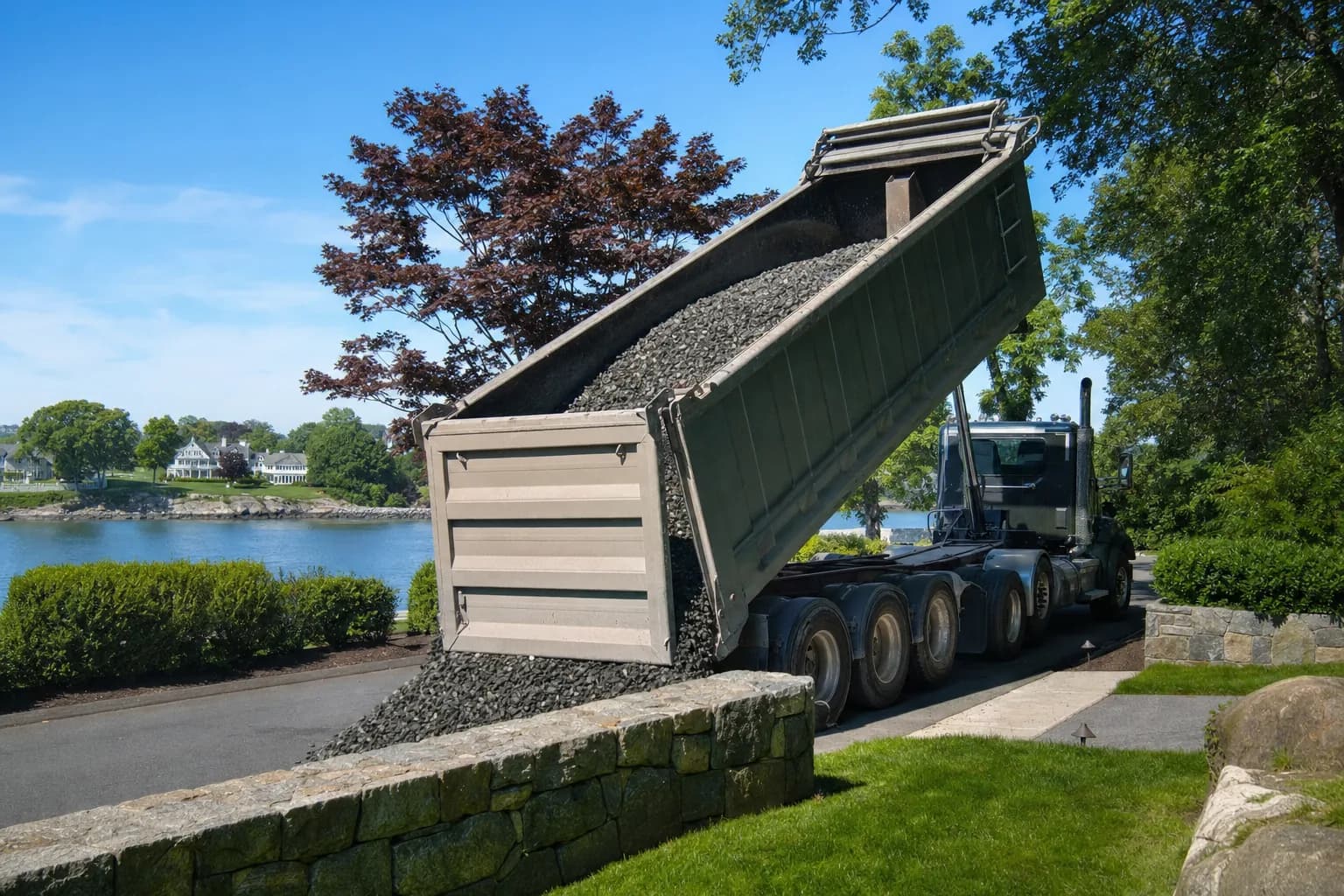
A dump truck unloads by raising a body full of several tons of stone. That needs level, firm ground and clearance overhead. On most properties the answer is the driveway or firm ground beside it, and the pile stays where the driver put it.
Back-yard drops are possible when a truck can genuinely reach the spot and turn around again. If it cannot, the driver unloads at the nearest safe place, which on a tight lot usually means the apron or the street edge. Before ordering, walk the route you are imagining and ask whether a loaded truck could reverse back out of it.
Stone walls, low limbs and a one-lane drive up from the road
The approach wants a clear lane about 12 feet wide, with no low branches and no sagging wires over it. Older Connecticut lots make that a real question rather than a formality. A dry stone wall along one side removes the room to swing wide. A gate post set for a carriage, not a truck, does the same. Maples that have not been lifted in a decade close the top of the lane in leaf.
Measure the narrowest pinch point and look up as well as sideways. If the answer is marginal, say so through the contact page before you place the order, not on the morning.
A cone at the drop, and elbow room round the pile for a wheelbarrow
You do not need to be there. What replaces you is a clear instruction and a visible marker: a cone, a flag, a stake, something the driver can see from the cab. Leave the access open, keep your phone to hand in case the driver calls or texts to confirm placement, and the drop will go where you meant it to.
Think about the pile itself when you choose the spot. It arrives as one heap, not spread, so leave room around it for a wheelbarrow and keep it clear of the garage door, the oil fill and anything you will need to get past that week.
Soft ground between the thaw and the first dry week
Spring is when this catches people. Ground that carried a truck in September can be saturated in late March, and till holds water at the surface instead of draining it away. A loaded truck on soft ground will rut it, and if the driver judges the surface unsafe to tip on, the load goes to firmer ground instead.
If the site drains badly, book the delivery for a stretch of dry weather, or plan the drop on the driveway and move the material yourself. The same logic applies at the other end of the year: frozen ground stops compaction, so base and paver work is generally a spring-through-fall job here anyway.
Weekday dates, a ZIP field, and what the confirmation carries
Delivery is arranged from the ZIP code you enter at checkout, where you also pick the delivery date. The dates offered are weekdays, and there is a field for where the load should be dropped, so the instruction travels with the order rather than resting on the cone alone. The site's current delivery offer is shown at checkout, so you see the terms before confirming, and you can check an address by ZIP before you start.
The order is then matched to a supplier in the network near that address, and an agent contacts you to confirm the exact delivery address. The confirmation names the date you chose and a local contact. On the day, unloading runs roughly 10 to 15 minutes. Work the quantity out on the calculators first, then set the tonnage for Processed Gravel or whatever else you need from the product list. Changes and cancellations run under the published refund and order-change policy, which the common questions set out.
Common questions
The side yard is still soggy from the thaw. Should I move the delivery?
Either move it to a drier week or take the drop on the driveway and wheelbarrow from there. A loaded truck on saturated till will rut the ground and may not be able to tip safely, in which case the driver will unload at the nearest firm spot instead of where you marked.
The drive is one lane between a stone wall and the house. How do I tell whether it is wide enough?
Measure the narrowest pinch, and measure it at mirror height rather than at the ground. A dry stone wall flares as it goes up, a carriage gate post leans, and both take a foot out of a gap that reads fine at your ankles. Then walk the same line looking up. If the narrow point is close to 12 feet rather than comfortably past it, take the drop at the road end.
What actually comes back after I order, and who do I talk to?
The order is matched to a supplier in the network near the delivery address, and an agent contacts you to confirm the exact address. The confirmation names the date you chose and a local contact, which is who to raise a placement change or an access note with.
The load is coming to a driveway two houses share. What should the drop instructions say?
Which side the pile goes on, what the driver will see when they turn in, and anything about the other household's parking. A shared drive is where a marker on its own is least reliable, because a car moved overnight changes what the spot looks like from the cab. Name a fixed thing to line up against, such as the second post or the corner of the garage.
Place an Order
There is no delivery charge for any order. Review the products, use the calculator, and place your order today.