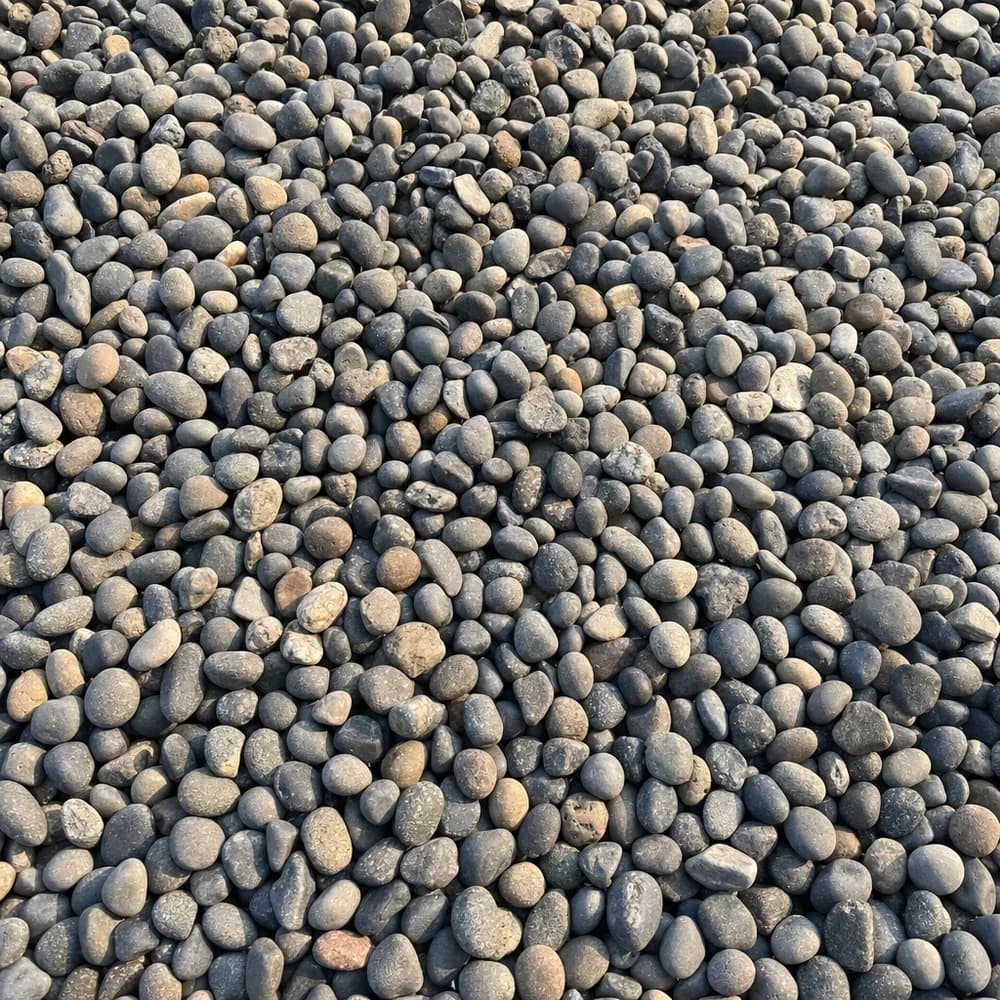
Pea Gravel Calculator for Connecticut Paths and Play Zones
Enter your project dimensions
Doubling the depth is the one instinct this stone punishes. Four inches of rounded 3/8 gravel does not feel twice as good as two; it feels like dry beach sand, where a heel sinks, a wheelbarrow plows, and the dog spreads half of it into the lawn by July. Pea stone works in a narrow band, two to three inches, and the pea gravel calculator here earns its keep once that number is settled rather than before.
Why the band is two to three inches, and what sits below it
Under two inches the ground shows through within a season, particularly on the shaded north side of a house where moss takes hold. Over three inches the surface stops supporting a foot. Three is the ceiling for anything you walk on.
Play areas are the one exception and they go the other way entirely. A fall zone under swings or a climbing frame is maintained at nine to twelve inches of loose material, which is not a surface anybody walks on comfortably. That is a fall-protection depth, and the equipment manual sets it, not this page. Be clear about what the tonnage buys, too: this is landscape pea stone, it is not sold as certified playground surfacing, and the required depth, the fall-zone footprint and the maintained depth all come from the equipment manufacturer's instructions rather than from us.
What goes underneath matters as much. On a patio or seating area, two compacted inches of stone dust first gives chair legs something to stand on. On a plain garden path over firm ground, the stone can go straight onto ground fabric.
Pacing a path that follows an old stone wall
Paths on older lots bend, because they were laid out around things that are still there: a wall, a well cap, a lilac somebody planted in 1960. Run the tape down the middle of the bend rather than along either edge, and take the width in three or four places, since the pinch point at the wall is usually a foot narrower than the open stretch.
Where a path opens into a sitting circle, measure that separately as a circle on its full diameter. Two shapes and one total is more accurate than one generous rectangle over the whole thing.
Feeding a bent path in as three rectangles
Rectangle, circle or multiple areas, and it is the multiple-areas option that suits this material best, because pea stone jobs tend to be several small spaces rather than one large one. It takes five areas at a time. Enter lengths, widths and diameters in feet and depth in inches from 0.25 up to 24, which is what lets a fall zone at twelve inches and a path at two and a half sit in the same calculation.
Select the material so the weight is right. The 5% box for compaction and spillage is worth ticking on this stone, less for compaction, which rounded gravel barely does, and more because loose 3/8 stone escapes: off the shovel, off the edge of the tarp, into the grass.
The result comes back in cubic yards, tons and cubic feet, with an option to email it to yourself.
Setting the edging proud before a single stone is dumped
Round stone rolls, which is the whole character of the material. A border that sits flush with the surface, or has sunk over a winter of frost heave, lets the stone walk out of the bed and into the lawn where the mower finds it.
Set steel, aluminum, timber or paver edging so the top stands about an inch above the finished stone. Check the line again in spring, because frost lifts pinned edging on till and drops it out of true. And on any grade steeper than roughly one foot in twenty, rounded stone moves downhill no matter what the edge does, so either lay a stabilizing grid under it or change material to an angular walkway gravel that locks together.
A 38-foot side path and a swing set fall zone
Illustrations rather than customer jobs.
The side path. Thirty-eight feet long, averaging 3 feet wide, 2.5 inches deep.
- 38 x 3 = 114 sq ft
- 114 x 2.5 / 12 = 23.75 cu ft
- 23.75 / 27 = 0.88 cu yd
- 0.88 x 1.40 = 1.23 tons, or about 1.29 with the 5% ticked
The fall zone. Nineteen by thirteen under a swing set, maintained at 12 inches.
- 19 x 13 = 247 sq ft
- 247 x 12 / 12 = 247 cu ft
- 247 / 27 = 9.15 cu yd
- 9.15 x 1.40 = 12.81 tons
The gap between those two figures is the point. The path is a wheelbarrow job on a Saturday. The fall zone is a bulk delivery, and no amount of bagged stone is going to get there.
Raking the worn line back, twice a year
Loose stone migrates along the line people actually walk, so a path develops a bald stripe down its middle and a ridge along both edges. Ten minutes with a landscape rake in spring and again after leaf fall puts it back. Keep a bucket or two in reserve for the worn line, and keep the leaf blower off the path entirely unless you want to redistribute the surface into the border.
Why a handful feels light and a yard weighs 2,800 lb
Rounded stone has less air in it than people expect once it is in bulk, so pea stone weighs the same as crushed gravel: about 2,800 lb per cubic yard, or 1.40 tons. At the working depths that comes out as:
| Depth | 1 cubic yard covers | 1 ton covers |
|---|---|---|
| 2 in | 162 sq ft | about 116 sq ft |
| 3 in | 108 sq ft | about 77 sq ft |
| 12 in, play area | 27 sq ft | about 19 sq ft |
Two tools sit close to this one. Use this page for 3/8" Natural Pea Gravel, the rounded stone people here call pea stone, on level paths, seating areas, fire pit surrounds and dog runs. Use the gravel calculator when the surface is angular crushed gravel for a slope or a busy route, and the river rock calculator when the stone is decorative and larger and is going into a bed rather than underfoot. Once the tonnage is right, set the quantity and delivery date on the product page, where delivery is arranged at checkout by ZIP code.
Common questions
The patio needs a firm layer under the stone. Do I order both at once?
Two runs, two products, one delivery. Two compacted inches of stone dust at 1.45 tons per cubic yard, then two to three inches of pea stone at 1.40. For a 12 by 12 seating area that is 144 square feet, so 24 cubic feet of dust, which is 0.89 cubic yards or 1.29 tons, and 36 cubic feet of pea stone at 3 inches, which is 1.33 cubic yards or 1.87 tons.
The path curves around a well cap and a lilac. How do I get a figure out of that?
Break it at the curve. Measure each straight-ish run down its centerline with an averaged width, then enter the runs as separate areas. Anything you cannot break into five pieces, run twice and add the totals. Small round obstacles are not worth subtracting unless they are larger than a few feet across.
The path has thinned in the middle. How much do I need to bring it back?
Measure the depth that is missing, not the depth you want overall. Push a trowel down to the fabric or the base in the worn stripe and in an untouched edge, take the difference, and enter that as the depth over the worn area only. Topping a whole path when the middle four feet is what wore out buys three times the stone.
What if I run short on a play area?
A fall zone at less than the maintained depth is not doing the job it exists for, so order it generously and keep the spare on a tarp behind the shed. That surface needs raking level and topping up regularly anyway, because the stone migrates out from under the swings faster than anywhere else on the property.
How much can I trust the figure for a path I paced rather than measured?
The arithmetic is exact, your inputs are not. Pacing a length is usually fine within a few percent; guessing an average width on a path that pinches at a wall is where the error comes from. On a job this size the honest approach is to take the width three times, use the middle figure, and round the tonnage up to the next quarter ton.
Related calculators
Under two tons covers most patios.
3/8 inch natural pea gravel, priced by the ton, delivered free.