River Rock Calculator for a Bed That Follows the House
Enter your project dimensions
The decision most people are really making on this page is not the tonnage. It is the stone size, because size sets the depth and depth sets the order. The same border finished in 3/4 inch stone at two inches and in 2 to 4 inch rock at five inches is two different deliveries, and only one of them will sit right against a fieldstone wall. Settle that first, then measure, then let the river rock calculator turn the beds into yards and tons.
Running a tape along a wall face, a bulkhead and a drip line
What we would check first is where the stone actually stops. Against an old foundation the bed usually ends at the wall face, not at the siding above it, and on a house that has been repointed those two lines can be four inches apart.
Beds on older lots rarely hold a straight edge for long. Take the length down the middle of the bed rather than along the grass, then take the width in three or four places and average them. A border that measures 30 inches at the corner and 40 inches beside the steps is a 35 inch bed for ordering purposes.
Anything round, a well head or a specimen tree ring, goes in as a circle on its full diameter across. If something sits in the middle of that circle, work out the inner circle separately and take it off the area before you type anything in.
A bulkhead, a basement window well or a set of granite steps interrupts a bed rather than ending it. Measure the run straight past the obstruction, then subtract its footprint if it covers more than a couple of square feet.
Beds, rings and four splash pads in one pass
Pick the shape at the top: rectangle, circle or multiple areas. Multiple areas holds up to five, which covers a front bed, a side border and a pair of splash zones without a second trip to this page.
Length, width and diameter are entered in feet. Depth goes in inches and accepts anything from 0.25 up to 24. Choose the material so the weight behind the ton figure matches what you are ordering, leave the box that adds 5% for compaction and spillage ticked if you want that margin, and press the calculate button.
Three numbers come back: cubic yards, tons and cubic feet. There is also an option to email the estimate to yourself, which is worth using if the beds are going in over two weekends.
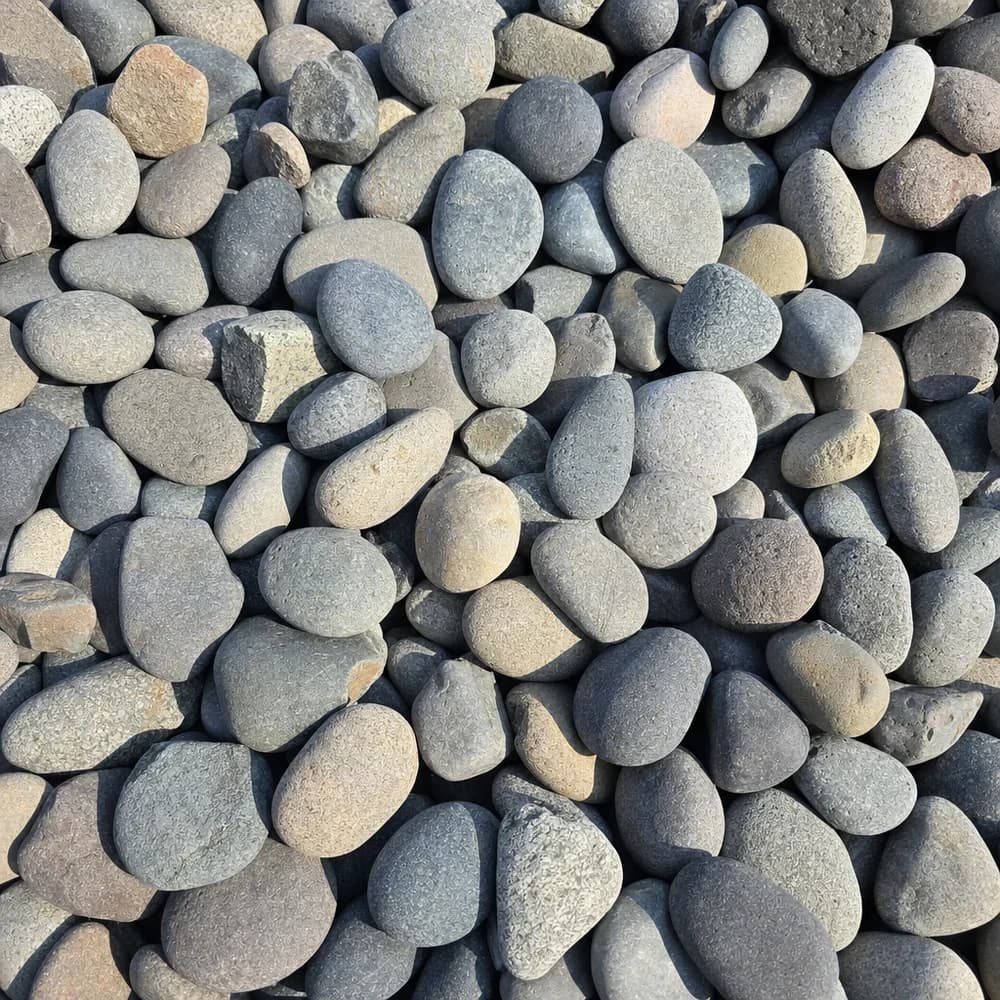
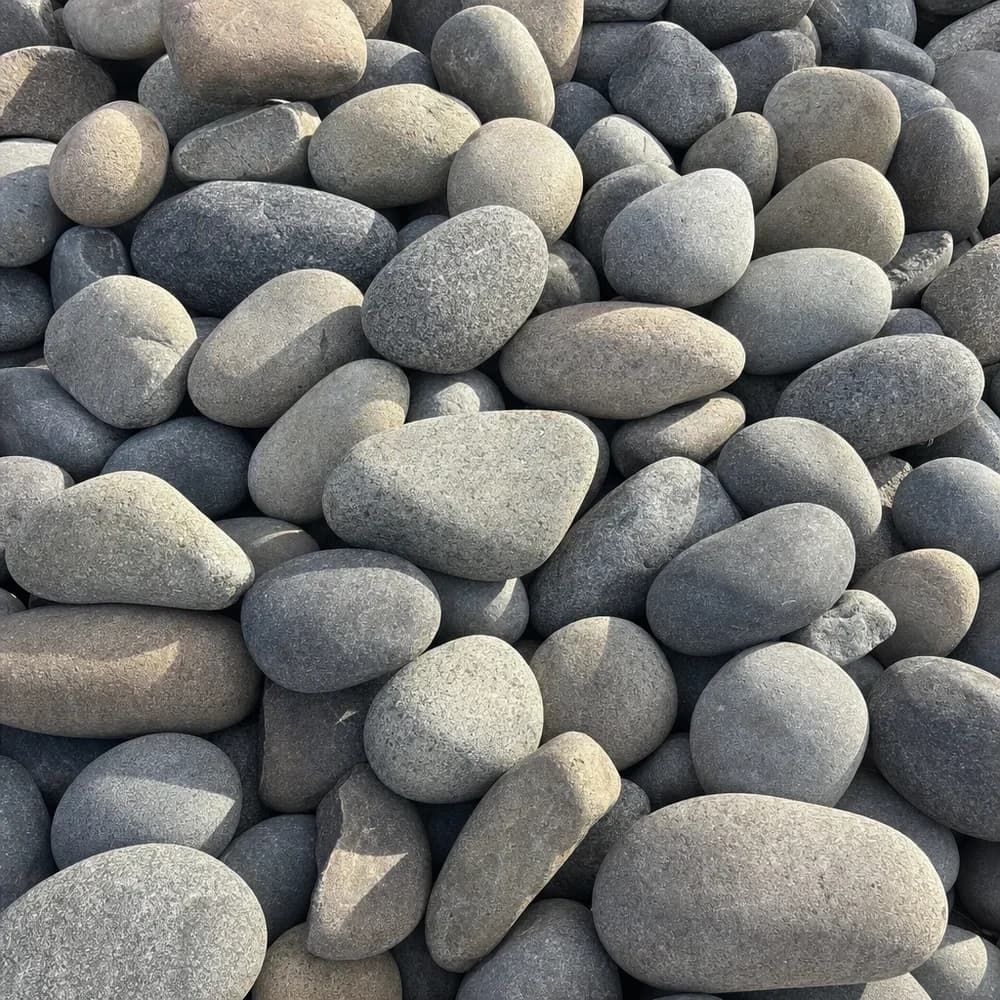
Two inches for 3/4 inch stone, five for rock you lift with both hands
The working rule is a layer roughly twice the diameter of the stone. Thinner than that and the fabric shows through after every rain; thicker and you are paying for depth nobody will ever see.
| Stone | Depth to enter | One ton covers about |
|---|---|---|
| 3/4 to 1 inch | 2 in | 120 sq ft |
| 1 to 3 inch river rock | 3 in | 80 sq ft |
| Large river rock, 2 to 4 inch | 4 to 5 in | 53 sq ft |
| Oversize accent pieces | single layer | 35 to 50 sq ft |
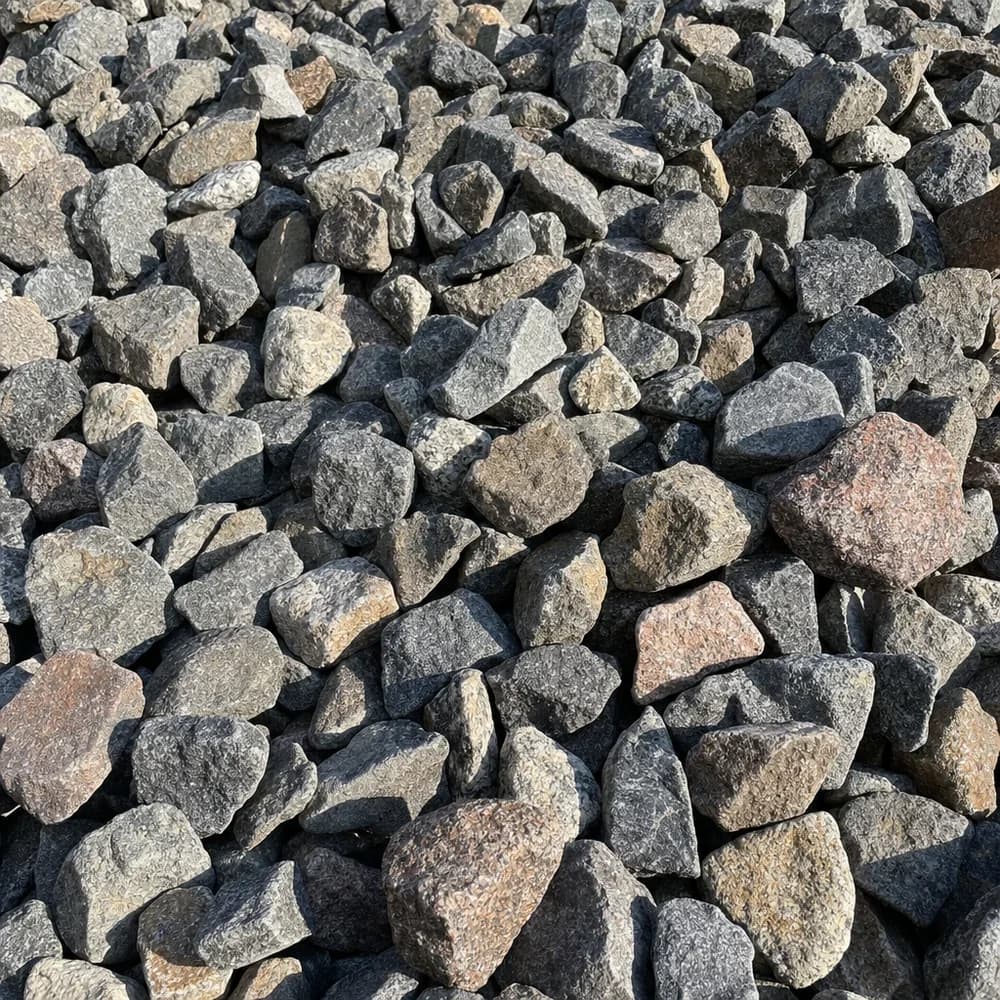
Drainage runs are the exception to decorative depths. A downspout line or a shallow swale carrying snowmelt wants the coarse sizes and a deeper layer, with washed drain rock underneath where the water is genuinely moving, because water moving after a February thaw will roll one inch stone out of a channel and leave it on the lawn.
Why 2,700 lb a yard makes the delivered pile look small
The arithmetic is length times width times depth in inches divided by 12, which gives cubic feet, then divided by 27 for cubic yards. Tons are those cubic yards multiplied by the weight of the material, and this site publishes river rock at about 2,700 lb per cubic yard, or 1.35 tons.
Run that backwards and a ton is only about three quarters of a cubic yard. Most people expect a ton of anything to arrive as a mountain, and a ton of rounded stone arrives as a heap you can walk around in four paces. Crushed stone at 2,800 lb per yard sits close to it; shredded mulch at 600 lb per yard is nowhere near, which is why the same bed can be a two ton order or a half ton one depending on what goes into it.
A 62-foot foundation border and four splash zones
Hypothetical jobs, with the numbers worked through so you can check them against your own.
The border around three sides of the house
Sixty-two feet of wall with a bed averaging 2.5 feet wide, finished in 1 to 3 inch stone at 3 inches.
- 62 x 2.5 = 155 sq ft
- 155 x 3 / 12 = 38.75 cu ft
- 38.75 / 27 = 1.44 cu yd
- 1.44 x 1.35 = 1.94 tons, call it 2 tons
With the 5% box ticked that becomes 1.51 cubic yards and 2.04 tons. Grade the finished surface so it falls away from the wall rather than sitting dead flat against it.
Four splash pads under the downspouts
Each pad 4 feet by 3 feet, entered as four separate areas, with large river rock at 4 inches.
- 4 x 3 = 12 sq ft each, so 48 sq ft in total
- 48 x 4 / 12 = 16 cu ft
- 16 / 27 = 0.59 cu yd
- 0.59 x 1.35 = 0.80 tons
Four small areas add up to less than a ton, which is the case for folding them into a larger order rather than ordering them on their own.
Fabric first, then stone, on ground that is mostly till
Glacial till swallows loose stone. Without non woven fabric underneath, a bed laid this autumn works its way down into the soil, and by the third spring it wants topping up. Pin the fabric down, then spread. In an active drainage route the fabric wraps around the stone instead of lying beneath it, which keeps fines out of the voids where the water moves.
Once the tonnage looks right, open the product page for the size you chose and set the quantity and the date there. Delivery is arranged at checkout by ZIP code, and the truck needs clear access to a firm spot to tip, which on a narrow lot usually means the apron rather than the back lawn. If you are not sure whether a bed wants decorative stone or a drainage layer under it, the stone calculator sizes the clean grades, and the contact page reaches someone who can look over your figures.
Common questions
The front bed turns the corner and runs down the side of the house. Do I measure it as one bed?
Enter it as two areas. Take the front run to the corner of the foundation, then start the side run from that corner, and let the multiple areas mode add them. Measuring an L as one long strip usually double counts the corner square and over orders by a few square feet.
The bed sits inside steel edging. Do I count the edging strip in the area?
Measure to the inside face of the edging, because that is where the stone stops. On a small bed the difference between inside and outside is a couple of square feet, but along 80 feet of border it is most of a wheelbarrow load.
I want coarse stone at the bottom of a wet spot and finer stone on top. Is that one calculation?
Two. Run the tool once at the depth of the drainage layer with the coarse size selected, then again at the top layer depth with the finer size. Each layer has its own depth, and the material select changes the weight behind the ton figure.
What goes in the length field when the border sweeps around the front of the house?
Walk the sweep down its middle with a tape, take that as the length, then average three or four widths across it. Handled that way a sweeping border lands within a few percent, and it errs slightly long, which is the harmless direction on decorative stone.
The existing bed has thinned out and shows fabric in places. How do I size a top up?
Measure the area as usual, then enter only the depth you are adding back, which is often an inch. Push a screwdriver down through a thin patch and a deep patch first, so the figure you enter is the difference rather than a guess.
Related calculators
Rock beds are a one-time buy.
River rock, large river rock and drain rock by the ton, free delivery included.