Rip Rap Calculator for Connecticut Banks, Outfalls and Shoreline
Enter your project dimensions
Armor stone is not decorative stone laid a bit thicker. Bed river rock across a border at three inches and a ton goes a long way; place riprap down a bank at the twelve inches it actually needs and the same ton covers about seventeen square feet. That single difference, four to six times the depth and a heavier stone on top of it, is why a rip rap calculator returns a figure that looks wrong to anyone who has only ever bought landscape rock. It is not wrong. The job is simply much deeper than it looks from the top of the bank.
Low water in late summer, storms from October on
The work has a season here and it is not the one people assume. Stream banks and pond edges run at their lowest in late summer and early fall, which is when the toe of the slope is reachable and the machine has somewhere dry to stand. That window closes when the ground freezes, and it is the same window that sits just before the storms.
Coastal surge along the Sound and the scour that follows heavy rain and thaw are what damage a bank in the first place, so the sequence worth aiming for is: walk the bank after the spring melt, measure over the summer, place stone in the fall while the water is low, then inspect after the first real blow. Stone set into a saturated bank in March does not stay where you put it.
Measuring down the face, not across the lawn
The commonest error on this page is a footprint measurement. A bank that is four feet high on a two-to-one slope runs eight feet across the ground but presents nearly nine feet of face. Measure the ground and you order about a tenth short, and the tenth you miss lands at the top of the bank.
So run the tape down the slope itself, from the toe to where the armor will stop, and multiply that by the length of the bank or channel you are protecting. Two figures, both taken on the ground you are covering.
Two other things to settle at the same time. The toe goes below the waterline, or below whatever scour depth you expect, because failures start at the bottom and work up. And the face wants to be at two-to-one or flatter before any stone goes on it, since a steeper bank than that is an engineering question rather than a question of buying more rock.
One thing to settle before either. Ask your state and local authorities what approval is needed before stone goes in below the ordinary high water line of a stream, pond or tidal shoreline. Armoring along water is commonly permitted work, what is required turns on the waterbody, and a tonnage page is no substitute for that call.
Entering a slope the tool treats as flat
The calculator does not know the surface is tilted, and it does not need to, because you have already measured the real area. Enter the slope-face length as one dimension and the bank length as the other, in feet.
Rectangle for a straight run. Circle, on the full diameter, for a plunge pool or a scour hole at a culvert outfall. Multiple areas, up to five, when one shoreline has three separate damaged stretches and one delivery is covering all of them.
Depth goes in as inches, from 0.25 to 24, which is exactly the range this work lives at the top of. Select the material so the 3,100 lb per yard is applied, and tick the 5% box for spillage, which on armor stone is really the stones that end up in the water rather than on the bank. Cubic yards, tons and cubic feet come back, with an option to email the estimate to yourself.
Layer thickness: 1.5 to 2 times the largest stone
The layer is set by the stone size, not by preference. One and a half to two times the largest dimension in the load, with twelve inches as the practical floor.
| Layer | 1 ton covers | Tons per 100 sq ft |
|---|---|---|
| 12 in | about 17 sq ft | 5.7 |
| 18 in | about 12 sq ft | 8.6 |
| 24 in | about 9 sq ft | 11.5 |
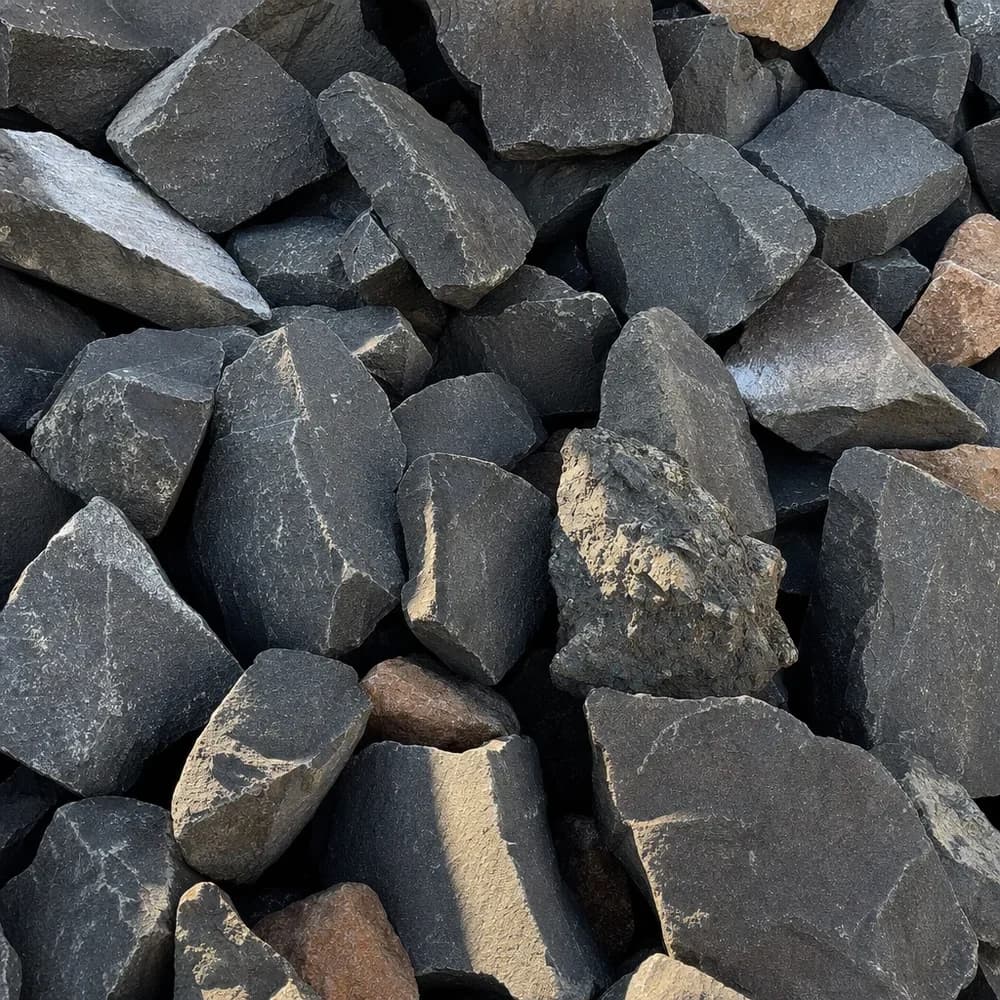
Size the stone for the water. Four to eight inch stone suits pond banks, downspout outfalls and slow streams. Eight to twelve suits shoreline exposed to boat wake and faster channels. Where a drawing exists for a highway, spillway or permitted shoreline job, the drawing governs and this page does not. If you are between two sizes, take the larger stone and the deeper layer.
Fifty-five feet of stream bank in the Quiet Corner
An illustration rather than a customer job. A run of bank 55 feet long with a slope face measuring 8 feet from toe to top, armored at 18 inches.
- 55 x 8 = 440 sq ft of face
- 440 x 18 / 12 = 660 cu ft
- 660 / 27 = 24.44 cu yd
- 24.44 x 1.55 = 37.9 tons, or 25.67 cu yd and 39.8 tons with the 5% ticked
A culvert outfall is smaller and rounder. A 9-foot apron entered as a circle gives 63.6 square feet, and at 12 inches that is 63.6 cubic feet, 2.36 cubic yards, or 3.7 tons. Carry an apron four to six pipe diameters downstream of the outlet, since that is where moving water cuts into the ground.
Fabric and the bedding course that go in first
Stone placed straight onto a bank settles into it as the soil behind washes out, so there is a layer before the layer. Either non-woven geotextile across the whole face, which a landscape supplier carries and this site does not, or three to four inches of #4 Crushed Stone as a bedding course, and on an exposed shoreline, both.
That bedding is a second tonnage. For the 440 square foot face above, 4 inches comes to 146.67 cubic feet, 5.43 cubic yards, and at 1.45 tons per yard about 7.9 tons. Run the calculator twice with the material changed rather than estimating it as a fraction of the armor stone, because the two weigh differently.
Set the top stones so they nest against each other rather than leaving them where the bucket dropped them. It is the interlock that holds the face together.
A reserve pile for the first nor'easter
Round up, and then keep some back. After the first serious storm, walk the bank and look for toe stones out of place, bare soil showing between the rock, and any sign of fabric. Ten minutes twice a year is the whole maintenance program, and having a few tons on hand behind the barn is the difference between a repair and a second delivery.
Check the approach before ordering as well. The last stretch of track down to a pond or a stream is often soft, and a loaded truck needs somewhere firm to stand and clear access to a spot where it can tip. Delivery is arranged at checkout by ZIP code once you set the quantity and date on the RipRap page.
If the stone is going into a dry creek bed for looks rather than into a bank that is actively eroding, you want the river rock calculator instead, and the bedding course is sized on the stone calculator.
Common questions
Is the layer depth measured loose or after the stone settles?
Loose, as placed. Armor stone is not compacted and is not meant to be, so the depth you enter is the thickness of rock sitting on the bank once it is nested together. That is different from every base material on this site, where the figure is the compacted depth.
The damage is a round scour hole below a pipe, not a straight bank. What shape do I use?
Circle mode, entered on the full diameter across the hole, plus a margin beyond the rim so the armor is not stopping exactly where the water is working. A tree ring or a fire pit surround would be entered the same way, though those are landscape depths rather than armor depths.
How do I check the number by hand before I order 40 tons?
Multiply the slope-face area in square feet by the layer depth in feet, divide by 27, then multiply by 1.55. For a 10 by 10 test patch at 12 inches that is 100 cubic feet, 3.7 cubic yards, about 5.7 tons. If your own figure and the screen disagree by more than a rounding, one of you has the slope face wrong.
Why does the same depth take more tons here than it would for gravel?
Because the weight per cubic yard is higher. Armor stone runs about 3,100 lb per yard against 2,800 for crushed gravel and 2,700 for river rock, so an identical volume comes out roughly eleven percent heavier than the same volume of gravel. The depth is doing most of the work, but the material weight adds to it.
Is the 5% enough on a job this size?
On armor stone, treat it as the minimum rather than the margin. Stones roll into the water during placement, the toe usually takes more than the drawing suggests, and you want a reserve pile for after the first storm anyway. Rounding 38 tons to 41 is a sensible habit on a bank you would rather not revisit.
Related calculators
Banks don't armor themselves.
RipRap by the ton with free delivery, plus the #4 bedding stone to go under it.