Crusher Run Calculator for Connecticut Drives Built on Till
Enter your project dimensions
Every tonnage figure for a drive in this state carries a footnote, and the footnote is the ground underneath. Ledge can sit a foot down at the top of a lane and four feet down at the turnaround, and a wet pocket in glacial till gives no warning until the plate compactor starts to sink into it. What a crusher run calculator will tell you honestly is the volume of the layer you intend to finish with. What it cannot tell you is how much of that layer the subgrade is going to take back.
What the number leaves out: soft pockets, old ruts and a subgrade that moves
What we'd check first is the surface you are measuring over. A lane that has been driven on for thirty years is not flat. The wheel tracks sit two inches lower than the crown, the edges have grown grass over an inch of old stone, and there is usually one shaded stretch that stays damp into June. Measure the average depth you want to end up with rather than the deepest rut, then treat that damp stretch as its own problem.
This material also tightens as it is rolled, by something on the order of ten to fifteen percent of its loose height. So the depth you type is the finished, compacted depth, not the height of the pile when it is raked out. Plan the layer at the thickness you want to still have after the roller has been over it twice.
Neither of those is a flaw in the arithmetic. They are the reason the estimate is a figure you commit to rather than a measurement of the hole.
Yards, tons and the 3,000 lb this material puts on the ticket
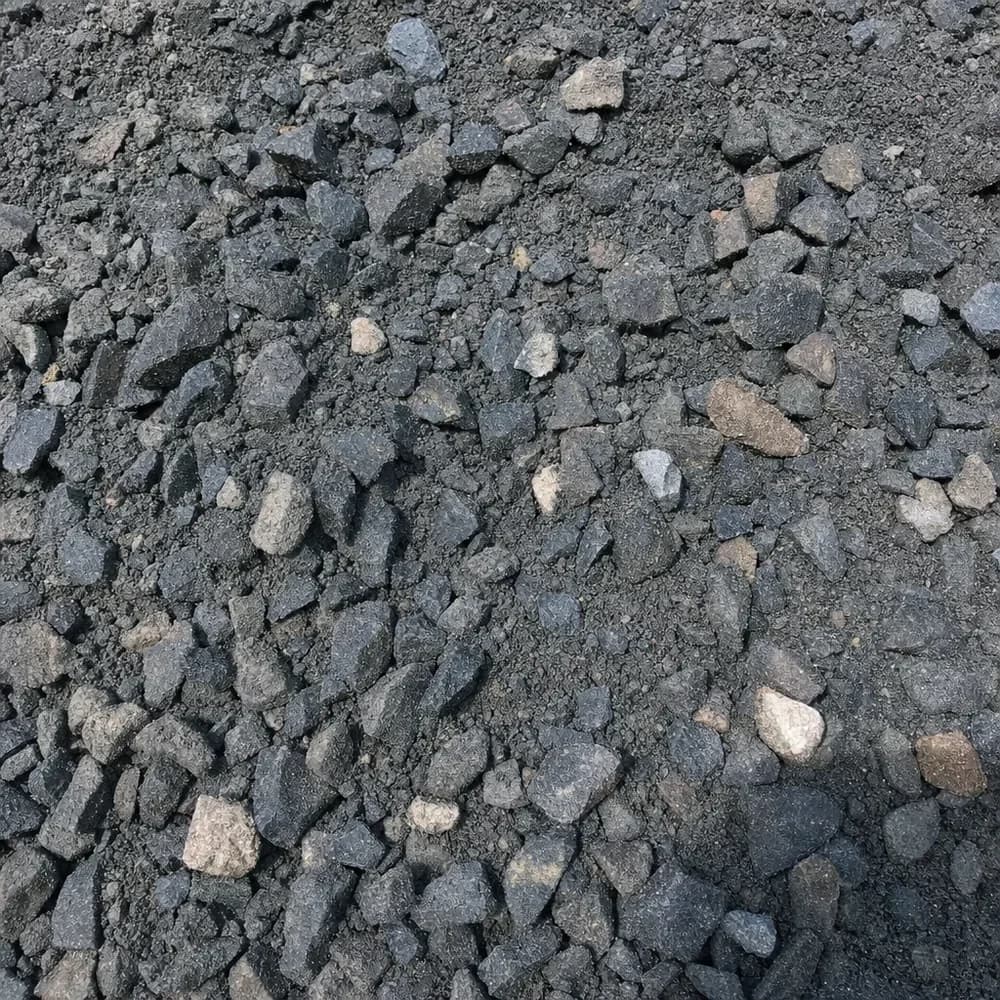
Crusher run is crushed stone with the fines left in, which is exactly why it binds. Those fines also fill the voids, so it sits heavier than clean stone: about 3,000 lb per cubic yard, or 1.50 tons. It is sold by the ton and thought about by the yard, and that conversion is the whole reason this page exists.
- Area in square feet, times depth in inches divided by 12, gives cubic feet.
- Cubic feet divided by 27 gives cubic yards.
- Cubic yards times 1.50 gives tons.
Rain adds weight without changing the volume you need, so order to the yardage and let the ticket weigh what it weighs.
Feeding in a lane that widens at the barn
Pick the shape at the top of the tool. Rectangle for a pad, circle for a turnaround entered by its full diameter across, or multiple areas if the drive changes width, which takes up to five pieces. Lengths, widths and diameters go in as feet, depth in inches anywhere from 0.25 to 24.
Choose the material so the weight is right, and leave ticked the box that adds 10% for compaction and spillage. On a base course that box is doing real work: some of the load ends up in the grass at the edges and some disappears into the ruts you are leveling.
The result comes back as cubic yards, tons and cubic feet, and there is an option to email the estimate to yourself before you leave the page.
Compacted depths for a path, a lane and the spot the oil truck parks
| Where it is going | Compacted depth | Note |
|---|---|---|
| Path or paver base course | 4 in | In two lifts, not one |
| Shed or hot tub pad | 4 in | 6 in where the ground is soft |
| Car drive | 4 to 6 in | Then a surface course over it |
| Delivery truck turnaround | 6 to 8 in | Heavy axle loads, wet season |
Frost runs down about 42 inches here and comes out of the ground unevenly, which is the plain reason a thin base lets go on older lots when a deep one does not. Build in two-inch lifts, damp each lift lightly before compacting, and take the 6-inch figure seriously anywhere a loaded truck turns.
One job this material should not be given is drainage. The fines that make it compact also hold water, so a French drain or a soggy trench wants clean stone instead. Size that on the stone calculator.
An 85-foot lane and a 10 by 14 shed pad
Both are illustrations rather than customer jobs.
The lane. Eighty-five feet long, averaging 11 feet wide once you have taken the width at four points, 4 inches compacted.
- 85 x 11 = 935 sq ft
- 935 x 4 / 12 = 311.67 cu ft
- 311.67 / 27 = 11.54 cu yd
- 11.54 x 1.50 = 17.3 tons
- With the 10% box ticked: 12.69 cu yd, 19.0 tons
The shed pad. Ten by fourteen, stripped of sod, 4 inches compacted.
- 10 x 14 = 140 sq ft
- 140 x 4 / 12 = 46.67 cu ft
- 46.67 / 27 = 1.73 cu yd
- 1.73 x 1.50 = 2.59 tons, or 2.85 with the 10% added
Run them as two areas in one calculation if both are going down the same week, since the material is identical and the drop is one pile.
Crusher run, processed gravel or paver base: picking the right tool
Three of the calculators here overlap, and the difference is the job rather than the arithmetic.
- Use this page for a binding base course or a low-traffic driving surface of Crusher Run.
- Use the processed gravel tool when the layer is going in as New England base aggregate, the 3/4 inch process a local contractor would spec. It is listed here as Processed Gravel and carries the same 3,000 lb per yard.
- Use the paver base tool for a patio or walkway, because that base has to run six inches past the pavers and the excavation depth has bedding sand and paver thickness in it.
For the travel surface over a finished base, size the top course separately as driveway gravel or 3/4 inch trap rock at 2 to 3 inches.
Rounding up before a second trip becomes the plan
Base stone is the wrong place to shave a figure. A lane that comes out at 17.3 tons is an order of 18, and the leftover half yard patches the potholes that show up at the end of the first winter. Round decorative stone down if you like. Round a base course up.
Once the tonnage looks right against your own sketch, open the product and set the quantity and date there. Delivery is arranged at checkout by ZIP code, and the truck needs clear access to a firm spot to dump, which on an older property usually means measuring the gap between the gate posts before anything else. If the figures want a second pair of eyes, Connecticut Rock Supply can look at them through the contact page, and delivery across Connecticut covers how the ZIP check works.
Common questions
The lane bows around a maple and a stone wall. What do I actually type in?
Run the tape down the middle of the bend for the length, take the width in four places and average them. If the drive widens at the barn end, make that a second area rather than stretching one average across the whole thing. The tool takes five areas at once, and two runs added together if you need more than that.
The drive is sound but the ruts need filling. How do I measure something that is already there?
Measure the wheel tracks, not the whole lane. A pair of tracks, each 60 feet long and 2 feet wide, comes to 240 square feet between them; at an average inch and a half deep that is 30 cubic feet, 1.11 cubic yards, or about 1.7 tons. Skimming a thin layer over the crown costs far more material than filling just the low line.
What actually goes wrong if I order light?
You finish half an inch thin across the whole lane, which is precisely the thickness that lets frost work on it. A base that comes up short is not a cosmetic problem to fix next spring with a bucket; it takes another delivery and another pass with the compactor while the first lift is still workable.
How close is this to the real figure?
Close on the volume, honest but approximate on the weight. The published 3,000 lb per cubic yard is a dry average, and a load that has sat in the rain comes in heavier without covering any more ground. Treat the yardage as the number to trust and the tonnage as the unit you are buying in.
The result is in tons. Where do I go next?
Straight to the Crusher Run product page, where you set the quantity, the delivery date and the delivery ZIP code. If the layer is really New England process for a drive base, use the Processed Gravel page instead. The tonnage carries across unchanged, since both weigh 1.50 tons per cubic yard.
Related calculators
Base tonnage sorted? Good.
Crusher run by the ton, the cheapest structure on the yard, delivered free.