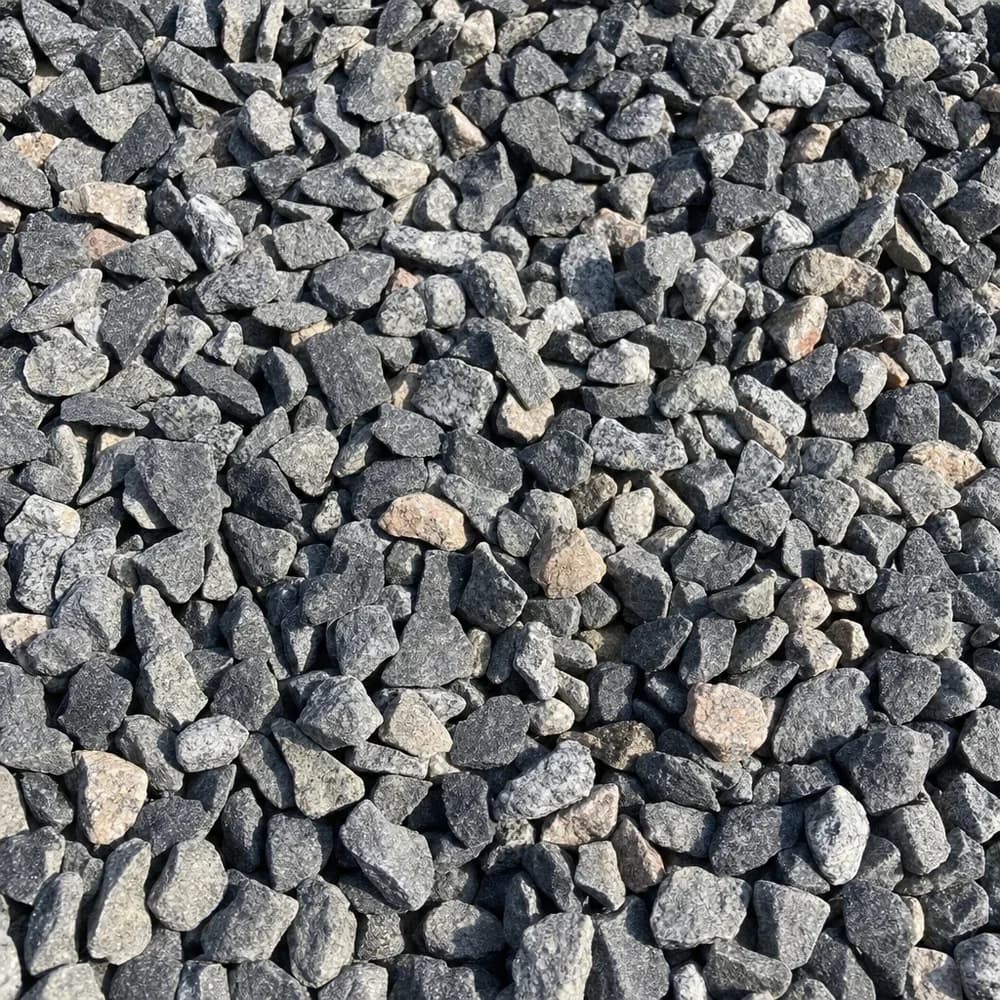
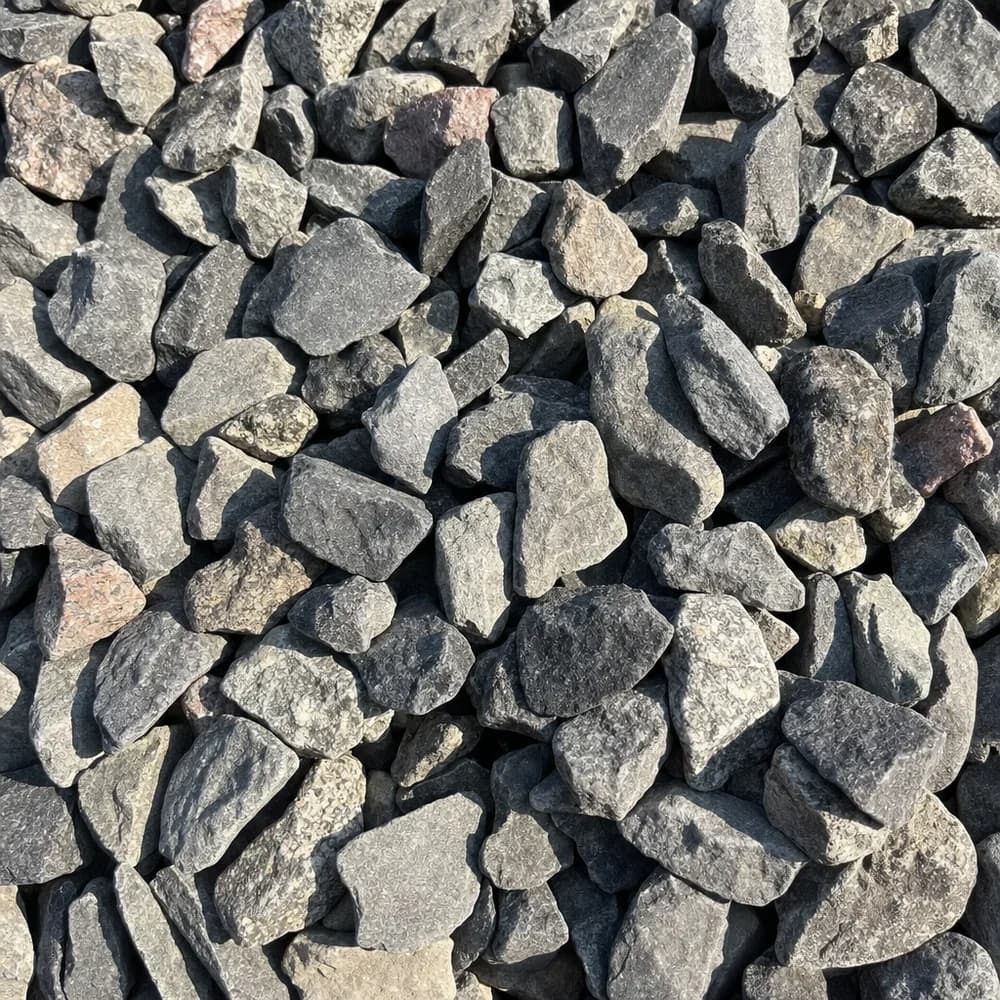
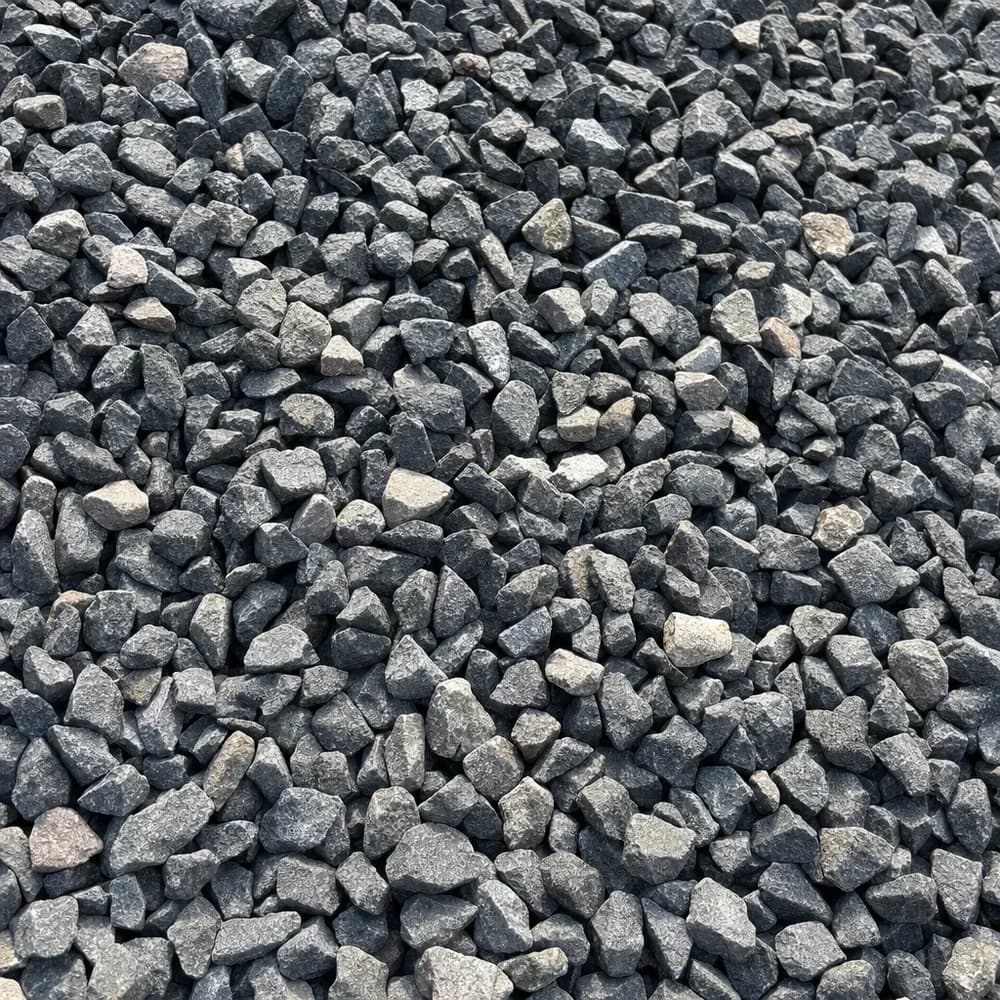
3/4" Trap Rock for Connecticut Aprons, Pads and Wall Drains
Also sold as 3/4" Crushed Stone
Also known as: trap rock, blue stone chips
Where Connecticut glacial till directs water sideways, 3/4" Trap Rock provides an angular layer for drainage and compacted base work.
- Size: Approximately 3/4 inch
- Type: Angular crushed stone
From $395 for 1 ton, delivery included
Larger loads cost less per ton: 500 tons is $24,175 ($48.35 per ton). Pick any quantity below for a delivered price.
Free delivery included
Free delivery anywhere in Connecticut
Pick a delivery date
Weekday delivery, earliest Oct 20
Get a Free Quote
Fill out the form and our sales team will get back to you within the hour.
Size and Grading
- Size
- Approximately 3/4 inch
- Type
- Angular crushed stone
The layer people call about most on an older lot here is the one nobody ever sees: the stone lift that goes back into a driveway apron after the soft till has been dug out of it. That is the everyday job for 3/4" trap rock, the angular gray-blue crushed stone sized at roughly three quarters of an inch with the fines taken out. It is also the stone behind a dry-laid wall, in the bottom of a wet trench and under a pad that has to stay put through a winter of freezing and thawing.
Trap rock, processed gravel and drain rock: three grays, three different jobs
The piles look alike from a truck window. What separates them is fines and size range.
Processed Gravel is the local base material, crushed stone with the fines deliberately left in so it binds. Compact it and it sets into something you can drive on. Put it where water has to pass and it does the opposite, because the fines fill the voids.
This stone is the same rock without the fines. Single-size angular pieces that seat against each other under a plate and still leave open space between them, so it carries load reasonably well and drains at the same time. That combination is why it ends up in so many layered builds.
Drain Rock is washed and spans a wider band, three quarters of an inch up to an inch and a half, in rounded or angular varieties. It is the buried drainage material, chosen because nothing in it can migrate into a pipe or a leach field. Where trap rock has to double as a working surface, drain rock rarely does.
#57 Stone sits closest of all, a clean graded stone in the same broad family. Where a drawing names a number, order the number.
Where 3/4" trap rock goes on an older property
Driveway and road base work is the first. Under an apron or a rebuilt section of lane, a compacted lift of clean angular stone gives a firm working platform that water can cross without standing in it.
Building foundations and footings are the second, where a clean stone layer under and around the concrete keeps groundwater moving rather than sitting against it.
Drainage systems are the third, in trench bottoms and around perimeter runs.
Retaining wall backfill is the fourth, and on this ground it is the one that matters most. Water in glacial till travels sideways, arrives behind a wall, and has nowhere to go unless the backfill is open. Angular pieces interlock and hold that open structure under the pressure of the soil behind them.
A dry creek bed that wants rounded stone instead
One request turns up often enough to name. A dry creek bed built out of angular crushed stone reads as a gravel trench rather than a watercourse, because nothing in a real streambed has sharp faces on it. The stone also sits tight instead of showing the variation that makes the feature look natural.
For the visible channel, use Large River Rock at the turns and the wide points, with River Rock through the narrower runs. Trap rock still has a place in that build, just out of sight: as the drainage layer under the channel where the ground beneath is heavy till.
Fabric, lift thickness and 42 inches of frost under a pole barn pad
Take a hypothetical pole barn pad, 20 feet by 16 feet, on a sloping till lot.
Frost in this state reaches about 42 inches and the cycle repeats all winter rather than happening once, which is what pulls a badly built pad apart. No backyard pad is going down below that line, so the whole strategy is to keep water out of the layer that can freeze. That means a lift of clean stone with fabric between it and the subgrade, and a finished grade that sheds rather than dishes.
Four inches of compacted stone is a sensible working lift for a pad of this size on ground that has been dug out and rolled. Deeper does not automatically help; what helps is that the subgrade underneath is firm and separated. Put it down in two passes with a plate rather than one thick spread, because a single deep lift leaves air in the middle of it.
Fabric is not optional on till. Without a separation layer the soft subgrade works up into the stone every spring and the lift quietly turns into a dirty layer that neither drains nor carries.
If the pad has to take a finished running surface for machinery, that goes on top as a compacted processed gravel course. This stone is the layer underneath it.
Tons for a 20 by 16 pole barn pad and a 10-foot fire ring
Two hypothetical numbers, worked as length times width times depth in feet, divided by 27.
The pad. 20 x 16 = 320 square feet. At 4 inches, 320 x 4/12 = 106.7 cubic feet. 106.7 divided by 27 = 3.95 cubic yards.
The fire ring surround. A 10 by 10 sitting area of clean stone around a fire ring, at 3 inches: 10 x 10 = 100 square feet. 100 x 3/12 = 25 cubic feet. 25 divided by 27 = 0.93 cubic yards. Angular stone suits this one, since it stays where a chair leg puts it and nothing in it burns.
Together, 4.88 cubic yards. This site publishes about 2,800 lb per cubic yard for #57, #67 and 3/4 inch crushed stone, or 1.40 tons per yard, so 4.88 x 1.40 = 6.83 tons. Order seven.
Run your own figures through the stone calculator, which handles the awkward shapes better than a pocket calculation will.
Ordering onto a drive with a stone wall on both sides
Older properties in this state often have a drive that was laid out for a cart, and a tri-axle load has to be tipped somewhere it can be reached with a wheelbarrow or a bucket.
Set the tonnage and the delivery date on this page once the excavation is open and the fabric is ready to roll out, so the stone can go straight in rather than sitting on the lawn for two weeks. Delivery is arranged by ZIP code at checkout and the truck needs clear access to a dump spot with headroom over it. If the only place the stone can land is at the top of the drive, or if a wall or a low branch limits the approach, raise it through the contact page before the date.
Quickly Calculate How Much You Need
Material: 3/4" Trap Rock
How to Measure
Measure the length and width of your project area in feet
Decide on depth in inches (2" for landscaping, 4" for driveways)
Enter the values above and we'll calculate the tonnage you need
Need help figuring out the right amount? We can help!
Call or text us at (860) 891-3260 and we'll help you calculate the right quantity for your project.
Not sure how much you need? The Stone Calculator has depth guides, coverage charts and worked examples for this material.
Frequently Asked Questions About 3/4" Trap Rock
3/4" Trap Rock delivery across Connecticut
- Bridgeport
- Stamford
- New Haven
- Hartford
- Waterbury
- Norwalk
- Danbury
- New Britain
- Fairfield
- Greenwich
- West Hartford
- Bristol